InferOps: The Category Nobody Named Yet
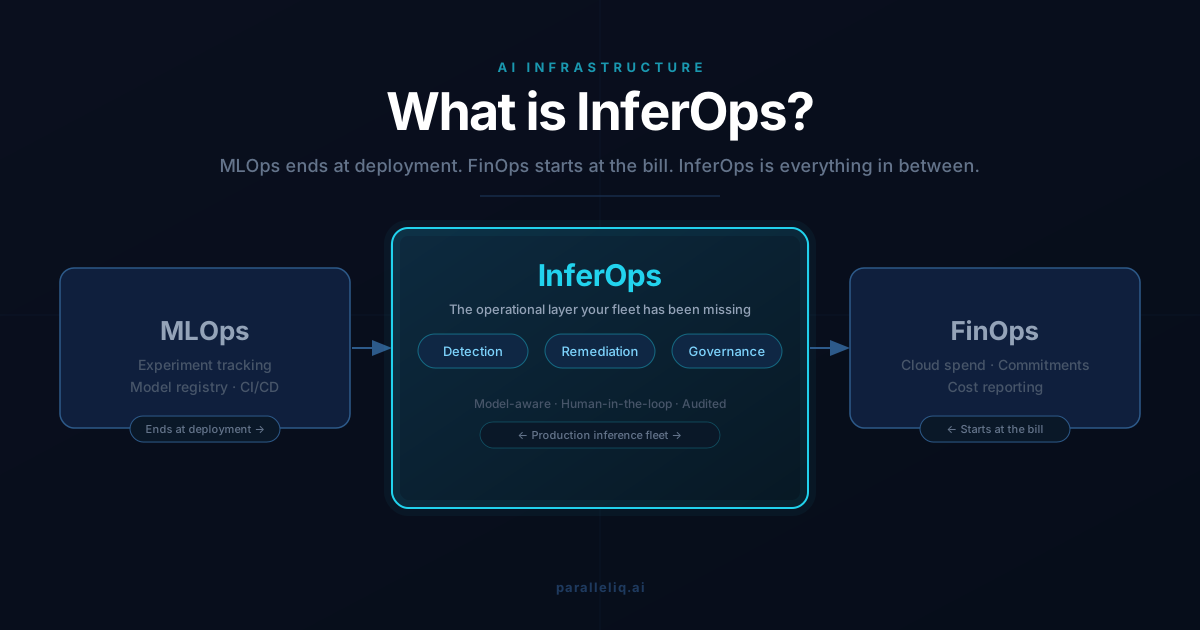
MLOps ends when the model is deployed. FinOps starts when the bill arrives. The operational gap in between — keeping inference fleets healthy, efficient, and production-ready — is InferOps. And most teams are doing it manually.
The Consulting Signal
When a new software category is real but the tooling doesn't exist yet, consultants appear. They fill the gap with human expertise — runbooks, engagements, fractional engineers who know the domain. It happened with DevOps. It happened with MLOps. It happened with FinOps.
Search for help with inference operations today and you find the same pattern: boutique firms, fractional GPU infrastructure engineers, AI platform consulting practices — all being hired to answer the same set of questions:
- Which GPU tier does this model actually need?
- Why is utilization low when traffic is high?
- What happens when we hit this VRAM ceiling under load?
- Who owns the runbook when a recommendation surfaces at 3am?
These are real problems, being solved by real people, for real money — and there is no software category name for it yet.
Until now.
---
The Gap Between MLOps and FinOps
MLOps covers the path from training to deployment. It ends the moment a model is live and serving traffic. FinOps starts when the GPU bill arrives. Between those two points — keeping a production inference fleet healthy, correctly sized, and efficiently operated — there is a discipline that most organizations treat as tribal knowledge.
That discipline is InferOps: the operational layer for AI inference in production.
The gap is widening fast. GPU inference is no longer a research concern — it's a production infrastructure problem at scale. Teams are running dozens of models across heterogeneous hardware, across multiple clusters, with traffic patterns that vary by orders of magnitude. The senior engineer who knew every deployment by heart doesn't scale. The spreadsheet tracking which model is on which GPU tier doesn't scale. The consultant who gets hired every six months to run an audit doesn't scale.
What scales is a platform. And platforms require a category name before they get built.
---
What InferOps Is Not
Before defining what InferOps is, it's worth being precise about what it isn't — because the adjacent categories are real and valuable, and the distinction matters.
InferOps is not MLOps. MLOps tooling — MLflow, Kubeflow, Weights & Biases — handles experiment tracking, model registry, and CI/CD for models. It stops at deployment. It doesn't know or care what happens to a deployed model's GPU utilization three weeks after it goes live.
InferOps is not FinOps. FinOps operates at the billing layer. By the time a GPU waste problem shows up as elevated cloud spend, the wrong GPU tier has been locked in for months. FinOps tells you the bill was too high. InferOps finds the problem before the bill arrives.
InferOps is not GPU monitoring. Prometheus, Grafana, and Datadog dashboards show you that metrics crossed thresholds. They do not tell you what those metrics mean for the specific model running on that specific GPU. A utilization drop on an agentic coding cluster is a CPU starvation symptom. The same drop on a batch inference cluster is a scaling opportunity. Generic monitoring cannot tell the difference — because it does not know what is running.
---
What InferOps Is
InferOps is the operational discipline for running AI inference workloads in production — covering detection, diagnosis, remediation, and governance of inference fleets at the model level, not just the resource level.
That phrase — at the model level — is the key distinction. Generic infrastructure tooling sees that a GPU is at 34% utilization. InferOps tooling sees that a Llama 70B deployment is at 34% utilization because CPU orchestration is starving it of work, and the fix is not more GPUs but more CPU cores. It sees that a 7B model is running on an H100 that only needs an A10G. It sees that a deployment is 8% from its VRAM ceiling and the next traffic spike will cause an OOM crash.
The findings are model-specific. The recommendations are specific. The remediation is human-approved and audited.
Three things make an InferOps platform real:
Detection with interpretation. Not metrics, but findings. Not "GPU utilization is 34%" but "this model is on the wrong tier and it's costing $3,200/month more than it should." The interpretation is what makes the detection actionable.
Human-in-the-loop remediation. GPU infrastructure mistakes are expensive and hard to reverse. InferOps tooling does not act autonomously — it surfaces a recommendation, explains the reasoning, and waits for operator approval. Every decision is logged.
Fleet-level governance. At scale, you need a record of what changed, who approved it, and what the outcome was — across every cluster, every model, every remediation. That audit trail is not optional for teams with compliance requirements. It is the record that makes governance provable.
---
Why Now
Three forces are converging to make InferOps a real category in 2026:
Inference is the dominant AI workload. Training gets the headlines, but inference is where the GPU spend is. Organizations running AI in production spend the majority of their GPU budget on serving, not training. The operational problems scale with the spend.
Heterogeneous hardware is the norm. A100s, H100s, L4s, A10Gs — inference teams are running multiple GPU generations with different memory profiles, bandwidth characteristics, and cost curves. Matching the right model to the right hardware tier manually does not work at scale.
The agentic shift is compounding the problem. Agentic AI workloads route tool calls through CPU orchestration layers before reaching GPUs. The CPU:GPU ratio that worked for pure inference breaks down for agentic workloads. Most teams discover this during an incident, not before.
---
The Source-Available Entry Point
The natural entry point into InferOps is a scanner — a read-only tool that can assess a running inference cluster without agents, without instrumentation, without changes to the cluster. It answers the first question every team needs answered: what is actually wrong with this fleet right now?
piqc is a source-available InferOps scanner for Kubernetes inference clusters. It runs as a Kubernetes Job, reads live deployment and node state, classifies findings by type and severity, and exits — leaving nothing behind. It is the fastest way to establish an InferOps baseline on a running fleet.
The optimization layer — recommendations, approval workflows, execution, audit trail — is what comes next.
---
A Category Worth Naming
DevOps took a decade to go from a conference talk to a job title. MLOps went from a blog post to a $500M+ category in five years. FinOps followed a similar arc, from spreadsheet discipline to a Foundation and a set of certified platforms.
InferOps is earlier. The consultants are there. The problems are real and compounding. The tooling is starting to appear. What's missing is the category name — the shared vocabulary that lets teams recognize they have an InferOps problem, search for InferOps solutions, and build InferOps practices.
This is that name.
---
Paralleliq is building the InferOps platform — starting with [piqc](https://github.com/paralleliq/piqc), the source-available GPU waste scanner, and the optimization layer that closes the loop from finding to fix. [Read more about what a model-aware optimization layer is](/what-is-a-model-aware-optimization-layer), or [start a conversation](/contact).